Omega
and (Anti-)Decay Atlas

  • (b. 1994, Guangdong, China) lives and works in Oslo, Norway. Chen received his MFA from the Oslo National Academy of the Arts in 2021 and his BFA from the Royal Academy of Art, The Hague, in 2019.

    Selected solo exhibitions include "Prophecies of the Post-Angel Era", Kunstnerforbundet, Oslo, Norway (2023); "Returnees", Kohn Gallery, Los Angeles, USA (2022); "Omega and (Anti-)Decay Atlas", Northing Space, Bergen, Norway (2022); "The Heimlichkeit of the Home", Fotogalleri Vasli Souza, Oslo, Norway (2021). Chen has participated in recent group exhibitions "Swallow Mountain, Drain Sea", Linseed Projects, Shanghai, China (2023); "Myth of the Cherry Tree", STANDARD (OSLO), Oslo, Norway (2023) and "Indoctrination: Multivalent Gestures", Fotogalleriet, Oslo, Norway (2023). 

    Chen's work is held in the collections of Institute of Contemporary Art, Miami, Denver Art Museum, Denver and The National Museum Norway, Oslo. "Portholes" marks the artist's first solo exhibition with the gallery.
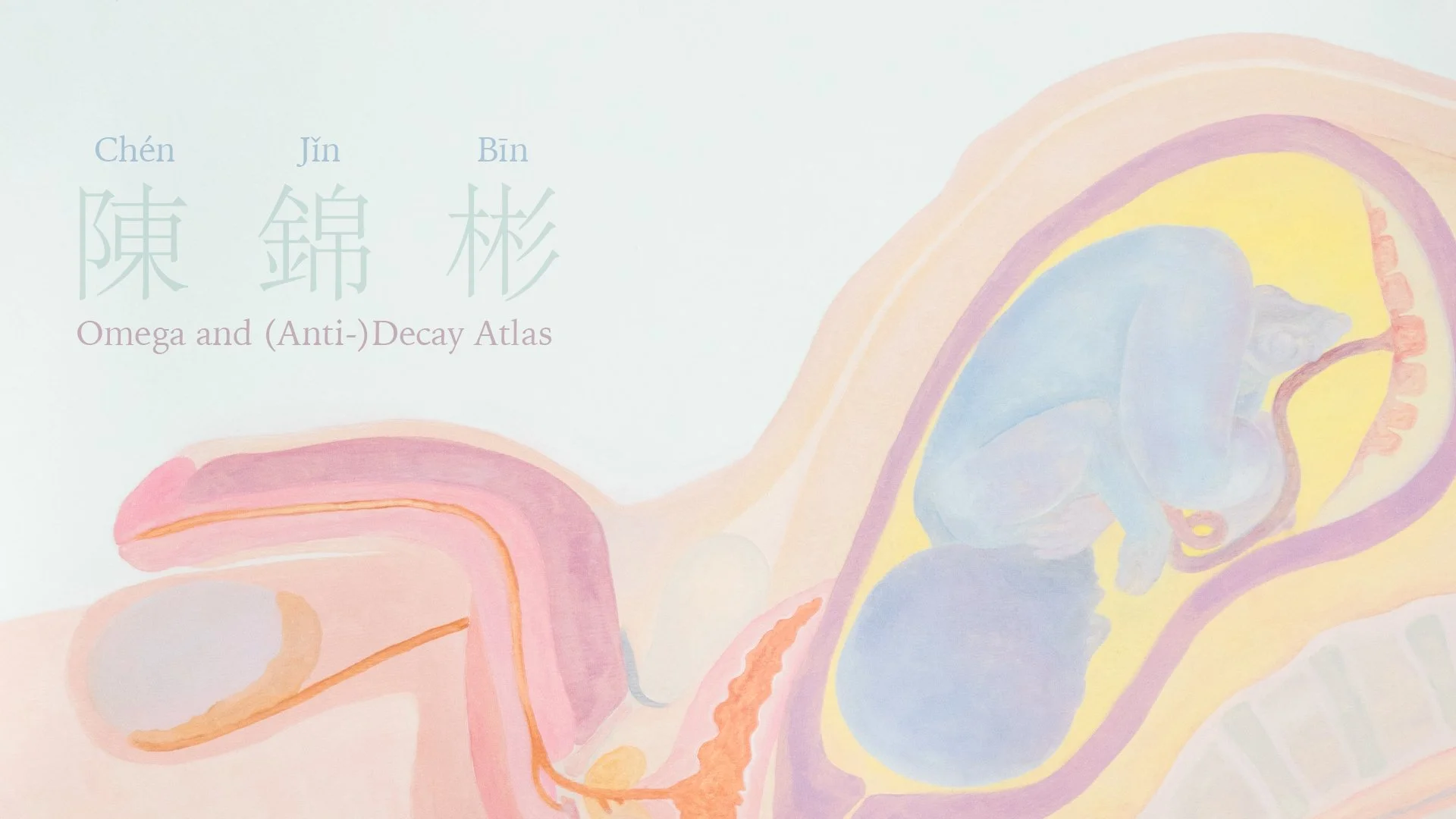
2nd April - 15th May

“Omega and (Anti-)Decay Atlas” takes its inspiration from a subculture called Danmei (literal translation: “Aestheticism”). Danmei as a genre, originates in China but is inspired by similar subcultures in Japan and the west, and has gained a large following in the two last decades. Its main manifestations are large amounts of online novels about male homosexual romantic/erotic relationships, written and read mostly by women.

Taking Danmei as a starting point: a subculture that negotiates gender roles through an almost perverse fetishization, the individual works in the exhibition seek to create a speculative narrative, or future scenario, surrounding gender roles and the hierarchies in-between them. “Omega and (Anti-)Decay Atlas” envisions ways in which bodies and identities could have functioned, as a means to make clear the inherent hierarchy that is always present in the politics of identity. The works can be seen as five different chapters in a novel, starting chronologically from our contemporary society and ending up in a distant future.

Integral to these future scenarios is the politics of decay, and the negative attitude of most contemporary societies towards what is thought of /misidentified as “decay”: to position the process of decay on the “outside” of any life-giving ecosystem is to actually pass it on to more vulnerable regions and populations. Instead, “Omega and (Anti-)Decay Atlas” starts by embracing that entropy and decay is at the core of who we are. By looking closely at our fear and denial of decay and heterogeneity, the exhibition explores the possibility of not only talking about decay within the framework of art and aesthetics, but also from the perspective of it as a universal and inevitable force of ecology and politics in our society. The works in this exhibition are especially invested in the ambiguous zones between order and chaos, between the collapse of old orders and the formation of new ones and between being and becoming, where organics and artificialities come together as indefinite life forms.