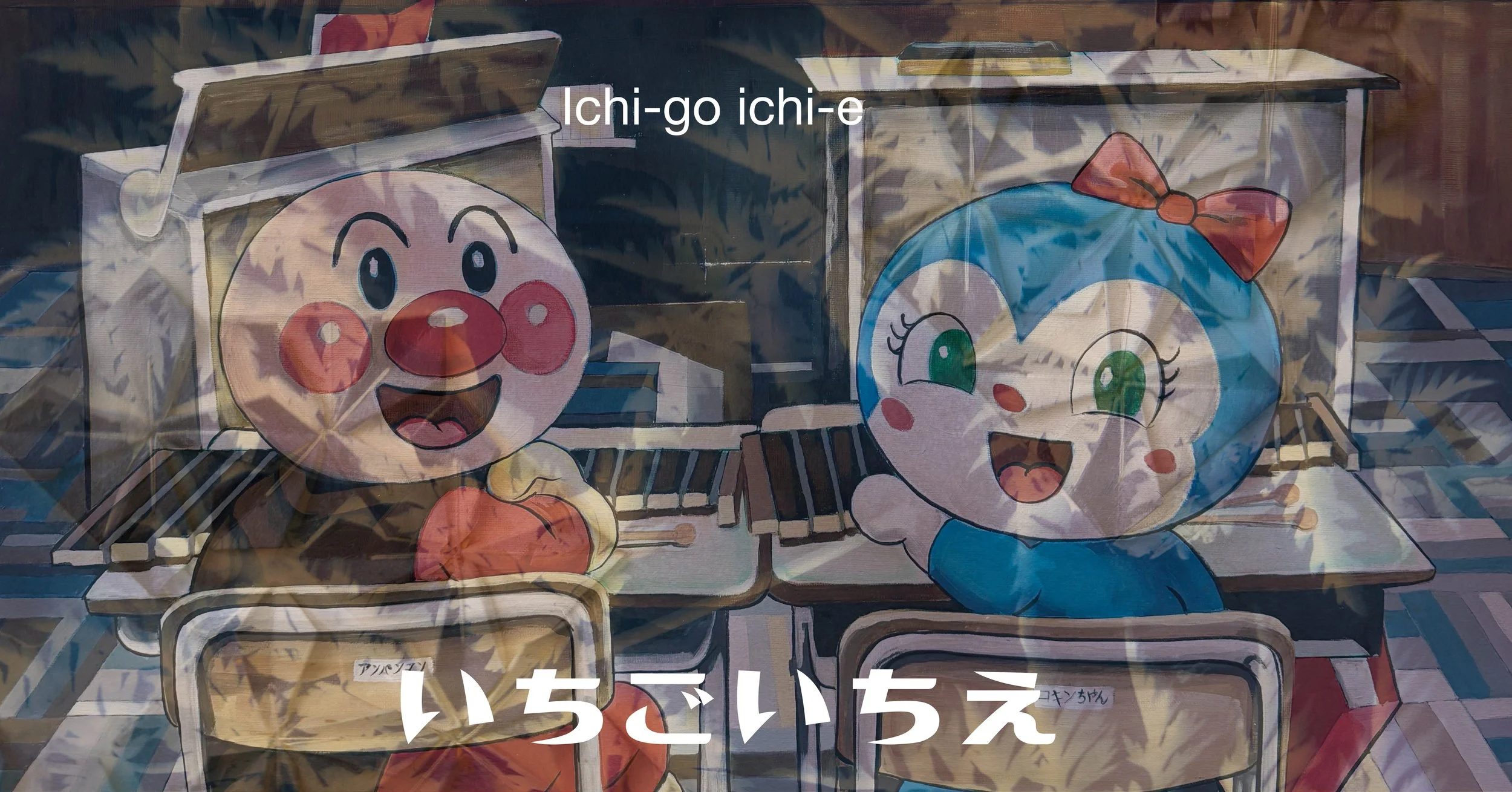
Ichi-go ichi-e
-
For many years, Solveig Sandvik has explored paper as an artistic medium, with impermanence serving as a recurring theme throughout her practice. Working across sculpture, installation, and film, she investigates processes of transformation, fragility, and change.
In recent years, her work has increasingly focused on the intersection of origami and printmaking. Through these combined practices, she explores the relationship between the slow, repetitive, symmetrical, and geometric on the one hand, and the spontaneous, intuitive, and organic on the other. Cyanotype, paper weaving, and printmaking are often integrated into her process, creating works that unite two-dimensional and three-dimensional forms into cohesive spatial compositions. Sandvik works primarily with monotype, a printmaking technique in which each impression is unique, emphasizing singularity and the unrepeatable nature of the image.
Born and raised in Japan to Norwegian parents, Sandvik has spent her life between two cultural spheres. This dual sense of belonging informs her artistic practice, where traces of both Japanese and Norwegian visual traditions can be discerned. She studied at the Bergen Academy of Art and Design and Tama Art University in Tokyo. Alongside her artistic practice, she works as a museum educator at KODE Art Museums and Composer Homes in Bergen.
-
Heidi’s body of work has moved between psychology and art, unfolding as a continuous interplay between being affected and affecting others. Drawing on a background in psychology, visual art, and architecture, she works within an emotional terrain in which structures, forces, and oppositions are held in tension, gradually dissolving into and transforming one another.
Her works often begin with narratives of beauty, or heartache, which are subsequently distorted and displaced, drifting towards the caricatural and the almost comic. She navigates between the composite and the abstract, between the recognisable and that which resists a fixed or unequivocal form. This movement constitutes a vital pulse within her practice.
For Heidi, stasis—an insistence on either abstraction or the composite—can become constricting. It is precisely the tension between these states that generates movement, allowing new connections and narratives to emerge. Her practice thus inhabits a space of transition, where opposing conditions are not resolved but kept in productive suspension, continually reshaping one another.